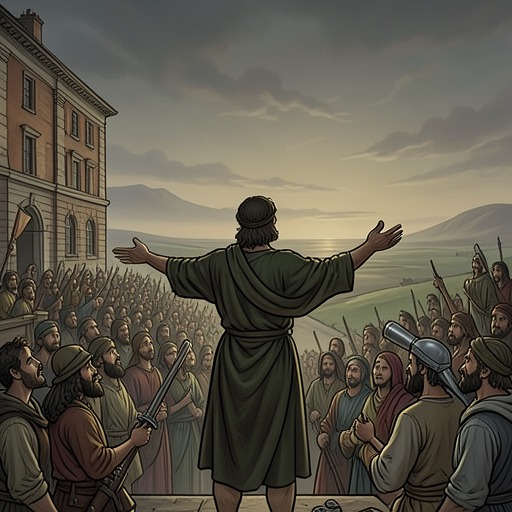
The Higher Men Gather at Zarathustra's Cave
Thus Spoke ZarathustraThe Higher Men Gather at Zarathustra's Cave turns a cry of distress into a gathering, then qualifies what that gathering means. Zarathustra discovers in his cave the troubled figures he has passed during the day and gives them shelter; yet he does not mistake their arrival for the fulfillment of his hope. They are omens of the higher, stronger, more joyful people he is still awaiting, and he will not descend from the mountains without them.
The cry and its summons
The gathering is prepared by an earlier exchange between Zarathustra and The Prophet of the Great Weariness. Zarathustra calls him a preacher of evil and asks whether he knows the name of the ultimate sin reserved for Zarathustra. The prophet answers that it is pity and says he has come to seduce Zarathustra into it. Their talk is interrupted by another cry, longer and more distressful than the first, and now much nearer. The prophet insists that the call is meant for Zarathustra and that the time has come.
Zarathustra falls silent, confused and deeply shaken. He asks who is calling; the prophet replies that it is the Higher Man. Zarathustra repeats the question in horror, asking what the Higher Man wants there, and breaks into a sweat. The prophet does not answer his distress: he listens towards the depths, then, after a long quiet, turns and sees Zarathustra still trembling. The summons therefore arrives not as an explanation but as a pressure that leaves Zarathustra visibly unsettled. Its identity becomes clear before its purpose does.
The many voices at the cave
Late in the afternoon, after searching and roaming in vain, Zarathustra returns home. Less than twenty paces from the entrance to Zarathustra’s cave, he hears the cry again. This time it comes from inside the cave: prolonged, manifold, and strange. Zarathustra can distinguish many voices within it, though from a distance they might seem to issue from a single throat. The sound first presents distress as a unified call; its source reveals a company of distinct people.
Zarathustra rushes in and finds those he has passed that day seated together: The King on the Right, The King on the Left, The Sorcerer, The Abdicated Pope, The Voluntary Beggar, The Shadow, The Conscientious Man of the Spirit, The Prophet of the Great Weariness, The Ass, and The Ugliest Man. Each figure belongs to the company that the day's encounters have brought within reach of Zarathustra’s cave. The Ugliest Man has placed a crown on his head and wound two purple sashes around himself; the narration connects this adornment to his love of disguising and embellishing himself.
Zarathustra’s Eagle and Serpent are present too. The eagle is agitated, its feathers ruffled, having been expected to answer questions to which its pride had no answer; the wise serpent hangs about its neck. The detail makes the scene more than a human assembly: even Zarathustra’s animal companions have been drawn into the company and its unsettled expectations. Zarathustra looks over the gathered figures with gentle curiosity, reads what is in their souls, and is astonished anew. They rise and wait respectfully for him to speak.
Shelter, welcome, and distance
Zarathustra recognizes that the cry he heard came from these despairing guests and that the Higher Man he sought in vain is now in his own cave. He also recognizes his part in their arrival: his honey offerings and the cunning bird-calls of his happiness have enticed them to him. Their presence is both a response to his summons and a surprise. They have come to him, but their arrival does not make them the company for whom he has been waiting.
He offers them his kingdom and domain for the evening and night. His animals will serve them, and Zarathustra’s cave will be their resting place. He promises security in his preserve, where he protects everyone from wild animals, and extends his welcome from a small first offer to his whole hand and heart. This hospitality answers the immediate distress of the guests with concrete shelter. The gathering is not only a portent: for that night, the cave becomes a refuge shared with those who have arrived.
The King on the Right has spoken of the company’s need to learn hope again from Zarathustra and grasps his hand to kiss it. Zarathustra resists this adoration and steps back, startled; after a short while he returns to address the guests plainly. The King on the Left privately reacts to Zarathustra’s promise to speak clearly and in plain German, taking the phrasing as a matter of uncouth German. The brief exchange sets admiration beside unease: Zarathustra offers welcome, but does not accept the role of object of devotion without resistance.
Omens, not the awaited company
Zarathustra tells the assembled guests that he has not been waiting in the mountains for them and that they are not the people with whom he may descend for the last time. Their significance is real but provisional: they have come as omens that higher people are already on their way. Among the qualities he distinguishes from what he seeks are great longing, great disgust, great satiety, and what the guests have called the remnant of God. Their arrival answers the cry, but not the larger expectation behind it.
He refuses to leave the mountains without the others. The people he awaits are to be higher, stronger, more victorious, and more joyful, square-built in body and soul, and like laughing lions. He then asks whether the guests have heard of his children and says they are on their way to him. The scene closes by turning the gathered company toward an anticipated future: the guests have found shelter and hope in Zarathustra’s cave, while Zarathustra keeps his purpose directed beyond them. The cry has brought the company together, but the gathering remains an announcement of what has not yet arrived.